Welcome...

This blog serves as a behind-the-scenes peek into the life and journal of an interdisciplinary artist. Learn more at merliguerra.com or luminariumdance.org, and thank you for reading my thoughts on setting the visual and performing arts into motion.
Showing posts with label Thoughts. Show all posts

Thursday, August 6, 2020

Something borrowed, something blue...

For me, marriage is about commitment and partnership. I never grew up dreaming of the perfect wedding nor what my dress might look like, and for a proposal, I insisted a Ring Pop was all I needed. (And a Ring Pop I got!) In my eyes, marriage was about the act of promising permanence, rather than the materialistic flourishes of a pricey wedding. 

But when Sean insisted on a traditional wedding rather than an elopement, I decided (in my typical scholarly manner) to research the origination of the popular rhyme "Something old, something new, something borrowed, something blue."


First off, American brides are missing out on arguably the most exciting line of this old verse! It turns out the original English version includes a final line, "and a sixpence in her shoe," signaling financial prosperity. You better believe I found a sixpence to add to my conveniently hollowed shoes...though being the rebel I am, I went with an Australian sixpence boasting a kangaroo and an emu. (Because who doesn't want a kangaroo in their wedding?)


For something old and something new, I turned to jewelry—with a fresh pair of earrings and sophisticated bracelet by Kendra Scott for the "new," and my great-great-grandmother's bracelet for the "old," symbolizing lineage and family who could not be present at the event.


Yet "something borrowed" had me stuck. The tradition calls for brides to borrow an item from someone in a healthy marriage, in essence a role model. Meg and Bob Marsden immediately came to mind. As longtime neighbors of my parents (and essentially a third set of grandparents for me), I grew up popping by their home regularly to show them my latest Halloween costume or, in later years, to chat with Meg about the latest fashion trends while she pointed out the "handsome young men" jogging by (who she had stopped with her walker earlier that week to casually inquire if they were single!). Meg was a role model of brains, humor, and tenacity. Her sharp wit never left her, even as her body deteriorated with age, and the supportive steadfastness of her marriage with Bob never ceased to amaze me. I particularly recall one occasion in which Meg discussed this and even proffered me advice: "Wait until you're 30 to get married," she advised, "That's what I did. You don't know who you are as a person until you're 30, and that's the most important thing to know before you marry."

Fast-forward many years later to Sean and me driving down the highway to visit my mother in Concord, MA... I had just told Sean how I wished I had something physical to "borrow" from Meg beyond her excellent advice; something tangible. Not being a member of Meg's family, I had no physical token from our friendship after her passing, only the memories of moments shared. Sean heard me, and it was because of this car-ride conversation that we both stood eerily stunned in my childhood home a few minutes later when my mother handed me a perfectly preserved envelope, saying, "Look what I found in my stack of old files today! I was just about to shred everything, but decided at the last minute to sort through it—and look, somehow this note from Meg was in there!"


I couldn't believe the timing of its unburial. There, in my hands, was the physical token I had hoped for in this cheerful note from Meg (dated 14 years prior), allowing my fingers to touch the indentations of the ever-familiar luscious handwriting.


That night, Sean and I enjoyed Restaurant Week at a Concord restaurant neither of us had previously tried, and I ended the day by emailing my father in Paris to tell him of the note's synchronous unearthing. In the morning, I awoke to a reply with yet another overlapping—my parents had dined at that same restaurant only once: the day of Meg's funeral.

Wanting to keep Meg close during the wedding, I dashed to my local Joann Fabrics, and immediately spotted a beautiful blue lace that would be perfect for making a simple pocket on the inside lining of my dress to hold Meg's note during the ceremony. Without reading the label, I walked up to the cutting counter, was handed a slip of paper and my folded blue lace, and headed for the register. It wasn't until I began getting antsy in line that I finally noticed the name of the color blue I'd selected: "celestial" (synonyms: "heavenly," "ethereal"). "Ok, Meg," I whispered under my breath, "You don't have to be quite so obvious."


So although my desire for elopement was thwarted by my ever-traditional husband, I am grateful to have delved into the symbolism of this traditional verse to bring good tidings. The strength of Meg and Bob's marriage was present physically and metaphorically that August day, and as I tucked Meg's note into my dress that afternoon (while Sean waited under a celestial blue sky), I remember laughing and shaking my head upon finally realizing—in a matter of weeks, Sean and I would both be turning 30.


This entry is lovingly dedicated to Meg and Bob Marsden of Concord, MA. 

My Marbles on a quiet floor entry from 2012 speaks more about my wonderful friend Meg.


Thursday, April 30, 2020

Red is the color of music

Childhood is a funny thing. For its inhabitants, it seems to go on indefinitely, yet in truth, it’s gone in an instant. Moments we take for granted as children later become cognitive snapshots we second-guess as adults—Was his mustache really that scratchy? Was the pool really that deep?—yet regardless, they leave a lasting impression, an invisible part of ourselves that impacts our lives moving forward, be they realistic memories or those warped through rose-colored glasses.

But when your cousin, Becky, one decade older than you openly shares her childhood memories of the grandmother you both shared, and they match your own nearly word for word, you know that your memories are not only accurate, but that the woman they depict really did, and does continue to, impact your life significantly.


When I think of my father’s mother, my Noni, I think of the color blue. Perhaps it’s because of the blue kitchen in which so many feasts were created and multiple conversations shouted across roomfuls of relatives (Many of whom I later learned weren’t relatives at all! But were always warmly treated as such.); maybe it’s because of the blue water of the above-ground swimming pool my cousins and I basically lived in during the summers (and that I accidentally nearly drowned my brother in, as I tried to teach him how to swim!); or maybe it’s simply due to the color of Noni and Pop Pop’s house—the feeling of sheer excitement upon seeing that blue exterior as we pulled into the packed driveway, and the accompanying sadness upon watching it (and my waving grandparents) gradually disappear as we left for home. 


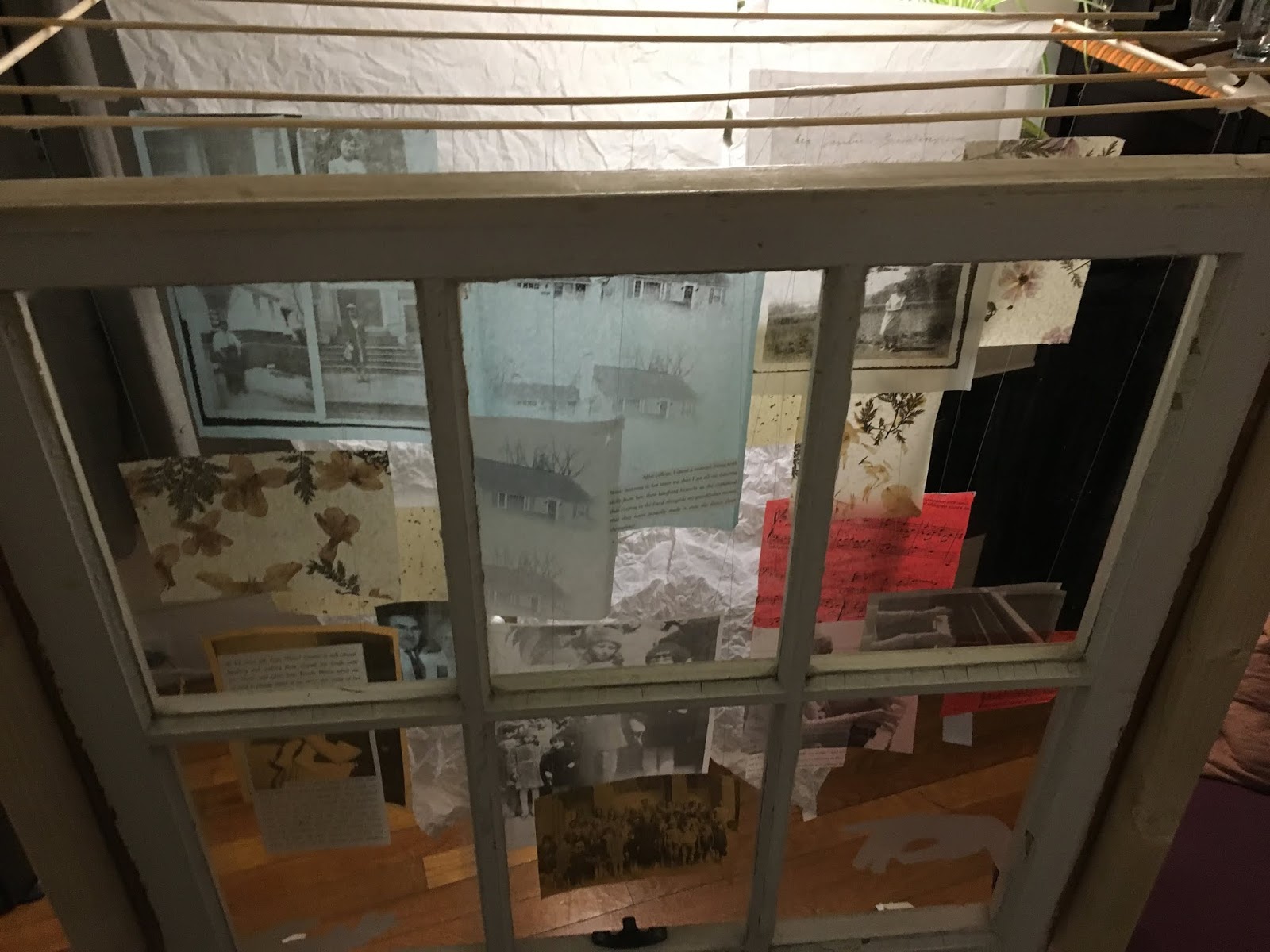
Pieces: Window Pane #2. Merli V. Guerra, 2017.

Blue was the color of happiness, of a warm embrace, of being passed from aunt to uncle to who-knows-who; blue was the color of the carpeted stairs that Erin, Jack, and I would slide down until we had rug burns or hit the floor a bit too hard; blue was the color of the ever-popular tacky backdrops in our annual school portraits that (although deeply embarrassing to look at) were always proudly displayed among dozens of other photos, old and new, on the wall above the living room sofa. And in later years (when I lived with her in the summer of 2009), blue was the color of my Noni’s nightgown, as we sat on that sofa: her, sassily teasing me and offering me food to the point of giggling and winking at me when I’d inevitably give in; me, sassing her back to make her laugh, and answering that evening’s three repeating questions with varying answers to keep us both entertained (as by then, her Alzheimer’s had truly begun to set in, especially in the evenings).

But red—red was the color of music.


Pieces: Window Pane #9. Merli V. Guerra, 2017.

As a lifelong professional-level pianist and organist, my Noni played every mass, every wedding, every funeral, all while teaching quite literally every child in “Western Mass” weekly piano lessons from the small music room in their home. Family gatherings would naturally spur impromptu duets between Pop Pop on bass or guitar and Noni on piano, with a Pied-Piper flock of grand- and great-grandchildren huddled round and adding the occasional spirited (yet out of tune) chord on the other end of the keys, which was always welcomed with laughter and delight. Between my Italian grandmother and Portuguese grandfather, food was certainly a huge part of every visit (You could show up unannounced and somehow there would undoubtedly be a roast chicken in the oven!), yet I would argue that despite every DIY Network show saying “the kitchen is the heart of every household,” here, at the Guerra’s, it was the music room that was the heart. While living with Noni years later, I’d awake (far too early) to sounds of Mozart and Beethoven—at times, romantic and passionate, at others fiery and complex—but always red. Red as the blood in her veins, the blood we share; red as the dress adorned by the pianist in the painting opposite her in the room. Red was, and continues to be, the color of music.


Noni and Pop Pop, assorted images.

Fast-forward to 2017: As the year started, I was already knee-deep in my We Create project, having begun my work as one of its selected 2016-17 cohort artists in September. I was honored to be chosen for this project run by Marsha Parrilla, Director of Danza Orgánica, and although I ultimately found the 2017 We Create Festival to be largely flawed in its execution, the piece I created through this process turned out to be quite poignant in more ways than one.

Through April, I continued to research and develop my initial concept: delving into the cohort’s 2016-17 theme of “hidden stories” by creating an art installation recognizing those with physical and mental disabilities. As my work unfolded, I found myself narrowing in on the specific story of my Noni’s struggle with Alzheimer’s, and society’s habit of tucking Alzheimer’s patients away—glancing by them only on the surface, unaware of the beautiful, multifaceted lives hidden within.

After many early sketches and conceptual notes, I eventually landed on the concept of peering through a window (itself, taken from the wall of my childhood bedroom, since knocked down…luckily, like me, my dad keeps everything!), to find layers of overlapping memories (some complete, some missing sections, and others seemingly looping on repeat), as this is often what Alzheimer’s does to the brain.


Pieces: The making of. Merli V. Guerra, 2017.


The construction process was difficult, as I knew I wanted each layer to consist of varying opacities, to blur into one another once eventually backlit by a simple table lamp. Scanning old photographs, I spent hours delicately taping tissue paper to cardstock, successfully printing one image, only to jam my printer on the next. By the time I reached the textual memories I planned to incorporate, I’d gotten a bit smarter (so I thought) by purchasing semi-opaque plastic film, only to learn the hard way that ink takes way longer to dry on plastic than it does on pulp! Ink-smudged hands and a healthy portion of swearing later, I embarked on the most tedious task yet: intricately hanging each image with thread onto thin wooden dowels acting as a trellis above.


Pieces: The making of. Merli V. Guerra, 2017.

Setting the full installation up in my tiny Boston living room, I was so pleased. Visually, the lamp, window, and images of Noni reminded me vividly of every evening visit on my way to and from Mount Holyoke College as an undergraduate, peering through the living room window to find her doing her crossword by lamplight. Symbolically, I was putting into physical form the age-old saying “Eyes are the window to the soul,” while the lamp served as the human spirit—still bright and beaming behind all those layers of misaligned memories.


Pieces. Merli V. Guerra, 2017.

My intention was to place an empty chair in front of the installation, encouraging audience members to sit and peer through the window panes, piecing together bits of the puzzle and learning about this beautiful multi-faceted woman by simply taking the time to do so. The goal was to speak to Alzheimer’s (and society’s treatment of the elderly) as a whole, reminding viewers that simply because an older individual might be slow to respond, it is not for a lack of knowledge, as they have years more experience than we, ourselves, have known. There are stories there, and when given the time, the patience, to peer through those eyes, we too can piece together the puzzles of these memories, and construct a truer image of who this person is, not was.


Pieces. Merli V. Guerra, 2017.

 I will keep this next section brief, as I do not want to dwell on my negative experience with the We Create process, but its outcome is key to the full experience of my installation, which I had titled Pieces. Explaining to Marsha just how delicate and complex an installation this was, I inquired if I should be setting it up during tech on Wednesday, or setting it up directly before opening night on Friday, as I wanted to be sure it wasn’t damaged in between. (My project was the only one that was an installation piece; the rest were various performance art works.) After being told Wednesday was definitely the day to do it, I carefully and lovingly spent a full two hours setting up the piece, complete with the chair, a lamp from our home, and a small write-up on the work.

Two days later, Sean and I entered the space to a bustling audience, a clearly lit stage, and—to my shock—no installation. I felt my heart plummet, as if I’d misplaced Noni herself somewhere in the room. Where could it be?? With Sean’s help, we eventually found it: literally shoved into a corner, the chair gone, the lamp unplugged, and several of my delicate tissue paper memories torn.


Delicately installing Pieces. Merli V. Guerra, 2017.

I was heart-broken, as my mind instantly replayed one of my “bad” visits with Noni earlier that year. I had shown up at her center to find her, and ten others, lined up along the wall in their wheelchairs waiting to be wheeled into the dining hall, and while I completely understand that the staff can only be in so many places at once, my Noni was at the end of the row, tucked around the corner, anxious and confused. I tried to calm her; tried to explain where she was and where she was heading next. I tried to show her photos of my parents; tried to remind her I was “the dancer” as she always called me (she regularly “auditioned” for my dance company while gliding through her kitchen in later years), yet nothing worked. Over and over she repeated, while crying, “I’m sorry; I’m so sorry I don’t know you. I’m so sorry I don’t remember these people. I’m so sorry I don’t remember who I am.” I held it together until the staff came to wheel her to lunch, then sat in my car and sobbed—not because she didn’t remember me, but because she was apologizing for forgetting herself.

It was amazing to me how the simple act of wheeling her into an empty hallway with no one around, no reminders of her family (photos, music), and no one to talk to, had led to that light briefly going out. And now here I was, staring at my forgotten installation—an installation whose purpose was to actively remind the public not to bypass the elderly by leaving them alone in a hallway (but to sit with them and learn from them), literally pushed aside, forgotten, and abandoned. As I hurriedly reset the now damaged work with Sean, the symbolism of this incident was lost on neither of us. (I later learned that the performance space serves as an after-school program for kids during the day, hence the installation was moved for “safety” reasons. My instinct to arrive early on opening night had been the correct one.)

Pieces: Window Pane #7. Merli V. Guerra, 2017.

As we left that night, taking Pieces home with us, a gust of wind hit us moments before placing the installation inside the car, causing all of my intricately threaded memories to instantly knot and entwine, as if permanently damaged. It seemed beyond hope to untangle it, nor did I know of another event I’d be showcasing it at down the road, yet I still felt compelled to make it right. As if performing a ritual, I spent hours upon hours carefully unbraiding each strand until all were back in their rightful place. I packaged it up for safe travel to our next destination, and it hasn’t been opened since.


Photo: Quincy Guerra Hepburn, 2020.

Fast-forward one last time to now: mid-April 2020. Never in my wildest thoughts would I have known that the entire world would be in quarantine; that my Noni (despite the staff taking incredible precautions) would be diagnosed with COVID-19; and that my family would be visiting her exactly as my installation had portrayed: spending time with her by peering through a window, sharing memories, and enjoying that precious light emanating from her soul as flickers of memories, her signature humor, and boundless love glow from the other side of the glass.

As I write this, I am trapped in New Jersey, whose quarantine is strictly enforced, and beside me (by pure chance), among all my disheveled art projects since moving into our new home, is the damaged, yet carefully preserved installation. I cannot drive up to stand outside the window; and even if I could, I cannot indulge in the comforting “blue” of that warm embrace; but there is one thing I can hold onto: This past December, not long after her 95th birthday, I visited Noni on the second floor of her building. Perhaps my hours of installation detanglement were finally paying off, because from the moment I entered the room, Noni and I shared the most incredibly lucid, loving, and joyous 2.5 hour visit (with poor Sean and Banksy waiting patiently in the car). “Where’s Sean?” she would ask, “He’s just so handsome.” “He has a bad cold, Noni!” I replied, “He didn’t want to take a chance and make you sick.” “But he’s so handsome,” she insisted (with a twinkle in her eye), “I’ll take that chance!”


Photo: Quincy Guerra Hepburn, 2020.

And so we sat together, chatting away like old times, showing her photos and videos from our summer trip to Scotland, photos of hikes in New Jersey during the fall, videos (on her request) of my recent choreography, and as I showed her a sweet video of Banksy opening an early Christmas present in my parents’ family room a few days prior, she suddenly paused—her hands cupping mine around the phone. “Play it again,” she said, peering closer, and so I did. Her eyes brimmed with tears as she pointed above my pup to the guitar on the wall, “That’s John’s. That’s John’s guitar!” “Yes, Noni!” I exclaimed, having become so used to my grandfather's guitar being there that I’d nearly forgotten. “Johnny, your grandson, plays it now.” She shook her head, crying yet smiling, “That’s so good. That’s so good… You know,” she reminded me, “John and I could never dance like you—we were too busy playing in the band; we never learned to dance!” Laughter returned to her soul, and I listened to her reminisce about my Pop Pop, her true love, and their deep connection through music.

And so, as I sit here feeling so far away, I will hold onto the fact that she and my Pop Pop will soon be reunited—a vibrant red reunion—for red is the color of music; their music.

_________________________________________

ADDENDUM: I completed writing this post on Thursday, April 30th, 2020, a little before 7pm. I read it aloud to Sean, sent it to my cousin, then heard the phone ring—my Noni had passed away just after 7pm.

This post is lovingly dedicated to Francesca Cristina Guerra (1924-2020). 

Monday, January 1, 2018

Top 10 Professional & Personal Highlights of 2017

2017 will forever be a year for the books.

I wish I could write that one sentence and call this annual entry complete, but I promised myself a while back to always take a moment at the start of each January to reflect on the year before—specifically, to document my top ten professional accomplishments—in an effort to remind myself that, Yes, I really did make progress in my career!

Yet 2017 was a little different, and for that reason, my top ten list is going to reflect this difference by encapsulating not only professional accomplishments and milestones, but personal ones as well.


Merli V. Guerra's art installation, Pieces, on view at We Create, 2017.

1. PROFESSIONAL: We Create

Stepping into 2017, I was already knee-deep in my We Create project, having begun my work as one of its 2016-17 cohort artists in September. Through April, I continued to research and develop my initial concept: delving into the cohort’s 2016-17 theme of “hidden stories” by creating an art installation recognizing those with physical and mental disabilities. As my work unfolded, I found myself narrowing in on the specific story of my Noni’s struggle with Alzheimer’s, and society’s habit of tucking Alzheimer’s patients away—glancing by them only on the surface, unaware of the beautiful, multifaceted lives hidden within. Although I ultimately found the We Create cohort to be largely flawed in its execution, the piece I created through this process turned out to be quite poignant in more ways than one. Find out why by reading my post Red is the color of music.


2. PROFESSIONAL: 2 New Commissions—Devil's Turn & Rosoff Awards

In past years, Spring has been a quieter time for Luminarium, which allows Kim and me an opportunity to use our Winter rehearsals in a gradual, constructively explorative way. Yet this season, similar to 2016, we found ourselves with a wild January through May as we prepared for back-to-back commissions, a weeklong residency at the Fuller Craft Museum, and invitational showings in NYC and Endicott College.

Our first set of commissions for the year was the long-awaited result of a collaboration with Boston New Music Initiative. Kim and I were each given a selection of contemporary orchestral works from around the world, and I quickly fell in love with John Allemeier’s The Devil’s Turn—inspired by the quick-tempoed fiddle reel of the same name. Incorporating fleeting moments of folk dance and paralleling the string quartet with a quartet of dancers, the new work debuted to an enthusiastic audience at BNMI’s Ars Nexa Tempora at the Center for Arts at the Armory in Somerville, MA, in April.

The second commission was a choreographic collaboration between Kim, myself, and the The Ad Club, who approached us to create a new to open the prestigious 2017 Rosoff Awards at the State Room in Boston, MA. The new quintet celebrated diversity, individuality, and the power of rising as a unified society.

Jess Chang performs Merli V. Guerra's Untitled Breathing Installation #2: Glass. 

3. PROFESSIONAL: Kinetic Craft

For my 2017 Cultural Community Outreach Project (the 6th project in this annual series), I successfully created a residency for Luminarium Dance Company at the Fuller Craft Museum in Brockton, MA, for the entire week of April school vacation. Every day from 10am to 5pm, Tuesday, April 18 through Sunday, April 23, 2017, five company members performed throughout the museum, personifying each of the museum's five crafting elements in my project Kinetic Craft.

Over the course of four months, I painstakingly constructed a series of “breathing installations”—a concept I first developed back in 2011 with my fabric installation for Luminarium's residency at the Boston Center for the Arts’ Movement at the Mills—this time highlighting four of the five crafting elements (Textiles, Wood, Glass, and Metal), while Kim tackled the fifth (Ceramics). Serving 471 visitors and featuring 12 company members and guest performers, Kinetic Craft successfully interwove movement with craft. For a more thorough synopsis with photos, videos, and testimonials, read my post “Kinetic Craft Residency in Review.”


4. PERSONAL: A Tale of Two Cities

In June, Sean and I relocated our lives to Princeton, NJ, for a job offer Sean couldn’t refuse. I don’t often speak about my personal life beyond the arts on this online journal (an intentional omission), but as I mentioned at the start of this post, 2017 marked many milestones in my personal life that merit public sharing. If I’ve never said it on here before, I regularly recognize how fortunate I am to have such an incredible partner. Yes, Kim is amazing, but this time I do mean my romantic partner. Sean is one of the single hardest working minds I know—and that’s coming from someone whose brain is constantly running! He approaches his work with a level of thoughtfulness, interest, and independence that cannot help but reveal results. As much as it saddened me to see the writing on the wall back in 2016 when he accepted a summer internship with Bristol Myers Squibb in New Jersey, I was also overjoyed to witness him working for a company that both pushed him and, at the same time, saw in him what I do. It came as a shock to my ever-under-estimating then fiancé (and as no surprise to anyone else in his life) when he was offered a rotational position with the company to begin in 2017. The work he has done since our move—and will no doubt continue to do—is astounding.

Luckily, New Jersey is a mere 6-hour drive from Boston, so my work in Massachusetts in most ways hasn't skipped a beat. As I settle into a groove of commuting back and forth for events (be it my own, or those I'm reviewing and supporting), I am confident that this relocation will proffer opportunities to further grow in my field. Already, I have met inspiring artists hailing from NYC, Philly, and the Garden State, with whom I hope to collaborate.

From a family perspective, the pace here is far slower than in Boston. It feels as though time can finally be given to long walks with my other half in the myriad of wooded parks peppering Pennsylvania and Central New Jersey, and our neighborhood is warm and welcoming (it took a while to get used to people saying "hello" to me on the street and not wanting anything in return!). Truly, there is beauty here in its more relaxed approach to life, and I look forward to our adventure unfolding as I balance my own Tale of Two Cities between Boston and Princeton.


Photos: Somerby Jones.

5. PERSONAL: Married

It's official! On August 12, 2017, Sean and I made a commitment to keep this party going all life long. Read my thoughts on the wedding (and my thwarted attempt to elope) in my post "Sorry, Sean. You're stuck with me."


6. PERSONAL: Puppy Parenthood

As Sean and I discussed the challenges and benefits of relocating, one benefit became excitingly clear: A move to New Jersey meant we would finally have space for a dog! No more cramped apartments with zero backyards; we would finally be able to bring a pup into our lives. A mere five days after our wedding, we traveled five hours to Virginia to pick up Banksy (yes, named after the elusive graffiti artist), our adorable little Goldendoodle. It’s been a nonstop rollercoaster of emotions ever since—from affection to frustration, amusement to worry—and while her name has grown to “Banksy Nala Piranha-Puppy Guerra” (or simply “Banksy Connolly” when she’s quietly behaving), this unpredictable ball of fluff has wriggled her way into our hearts for good. You can follow Banksy on Instagram @banksysighting for daily updates on her shenanigans.


Photo: Brian Bolanowski.

7. PROFESSIONAL: Outlet Dance Project

Luminarium made its New Jersey debut this fall at the impressive Grounds For Sculpture in Hamilton, NJ. I felt honored to be selected as one of the choreographers creating new work for The Outlet Dance Project, as it meant my own New Jersey artistic debut as well. Performed by Kim and myself, Weathered was created in relation to Linda Cunningham's striking bronze sculpture War Memorial III. This towering duet used 1970s CBS Vietnam newscasts as a sound score—at times, standing tall as the heroes of war, and at others, becoming engulfed by the darkness as were the civilian and military victims of battle. I described the impetus behind the new work in my application proposal:

“As a choreographer and visual artist, I often find my work revolves around the concept of the present intermingling with the past. Be it facing a past iteration of one’s self, or connecting with those who came before us, my work has been described as “haunting,” and “cyclical.” So, too, do I feel this when witnessing Linda Cunningham’s War Memorial III, whose abstracted towers of bronze strike the eye as both piercing upward through the ground while simultaneously melting back to whence they came. Researching the installation further, I find this duality of rising and falling to be beautifully metaphoric—from standing tall as veterans to withering and being forgotten, this “war memorial” begs to be set in motion.”

Performed on October 7, 2017, Weathered will hold a special place in my memory for years to come—in addition to marking my first Mid-Atlantic performance, it happened to fall on my 30th birthday! Not only that, but the sculpture itself was created in 1987, so it, too, was celebrating its 30th year on this earth. Call me sentimental, but there is something satisfyingly synchronous about marking that key milestone together (not to mention spending the day with poor Kim, who was sweating buckets under 40 yards of black satin in the 90 degree sun!).


8. PROFESSIONAL: Leaving Art New England

Relocating to New Jersey meant a shift in my work as a designer as well. In October 2017, I officially resigned from my role as Art Director of Art New England magazine. During my five-year tenure at ANE, I oversaw the magazine’s growth from 60 to 120 pages, bi-monthly; designed its feature, column, and review layouts; and mocked up a total of roughly 1,500 covers (only 28 of which ever made it to fruition). Nothing quite compares to holding the physical manifestation of a project in my own two hands—thumbing through its pages, and marveling at the cover’s fully-realized design. Equally engaging are feature layouts, which have proffered me the most room for creativity—from discussing the piece as a whole with the editor to enhancing the writer’s words through imagery. As I move on, I’m grateful for the friendships I’ve made while holding this position, and for the breadth of artists I’ve had the pleasure of working with and promoting nationally.


9. PROFESSIONAL: Dance International

In the fall, I was proud to add another publication to my list of freelance dance critic assignments: Dance International magazine. My first review for this Canadian-based print publication is set to appear in the February issue, and I’m grateful to its Editor Kaija Pepper for helping me adjust to the magazine’s writing style. Keep your eyes peeled for a piece on Boston Ballet’s Obsidian Tear, with works by Jorma Elo and Wayne McGregor.


10. PROFESSIONAL: Moderated 100 Years of Modern Dance

At this stage in my career, I’ve spoken on a variety of panels covering the topics of entrepreneurship, choreography, arts funding, and legislation, to name a few. I ended 2017 with a new panel experience: as moderator. I was delighted when Kathy Hassinger, Artistic Director of Dance Currents, Inc., invited me to moderate her post-performance panel for 100 Years of Modern Dance at Green Street Studios in Cambridge, MA. In November, I had the honor of guiding a dialogue between local dance mavens Marcus Schulkind, Margot Parsons, Joanie Block, Ali Smith, Samantha Govoni, and Whitney Cover to an engaged audience who commented they wished the conversation could have gone on much longer! The event was a wonderful end to the year, and pushed me to participate in panels in a new capacity, while trying my best to employ my Libra balancing skills.

Thursday, August 31, 2017

Sorry, Sean. You're stuck with me.

The not-very-Merli wedding bouquet I was gifted pre-Ubering.

Not long after getting engaged, my friend Jenny set us wise to the wonders of engagement events hosted by venues throughout Boston as a ploy to lure young couples into their pricey grasps. One such event—at a venue I’ll refrain from revealing—threw quite the impressive shindig, complete with full buffets on every floor and open bars around every corner. Having been kind to the florist in attendance, Sean and I were handed their display flowers at the end of the night: a boutonnière for an already dapper-looking Sean, and a luscious bouquet for me. Hugging Jenny goodnight, we hopped into the back of our Uber shared ride, and proceeded to head to the driver’s next pickup. An older woman soon climbed into the front seat, did a doubletake at the two of us—dressed to the nines and flowers in hand—and finally asked “I’m sorry but…did the two of you just get married?” Sean laughed and shook his head as I immediately blurted, “It’s so funny you ask! I was just telling Sean we’ve got the flowers and look amazing…why not get married tonight?” “Well what are the odds,” our stranger replied, “I’m a minister!” “And I’m a witness,” chimed in our otherwise grumpy driver.

At this point, I apparently turned wide-eyed to Sean who, ever the voice of reason, calmly reminded me that “everyone we know would kill us.” Recognizing defeat, I thanked our fellow passenger, and continued to smile in the dark at the thought of a spontaneous, cost-free wedding.

...

Over the years, I’ve seen friends post their thoughts on weddings, be it their own or in response to society’s view of them in general. Some view it as a chance to realize their childhood fantasies of the “perfect, magical day;” some deem it a religious necessity; and others argue that getting married isn’t an “accomplishment” and should not be exalted as such. Whatever your own views may be, here are my own: I agree that marriage is not an accomplishment, but I do view it as one of the most important commitments one can make (or not make, if that’s your choice!). It is the formal recognition that not only have you found someone you value to the point of sharing your life with them, but also that you agree to be their partner emotionally and physically from this day onward.

Personally, I never dreamed of my wedding. I never crooned over wedding dress magazines or thought about how I’d style my hair. In fact, I downright laughed when one popular wedding website (who bought my email from who knows who) sent me an Urgent Reminder! that my wedding was only 365 days away and in order to stand any chance of looking beautiful for my ceremony, it was imperative that I start my wedding beauty regimen now! Can you imagine? 365 days of torture! But I digress… No, for me the perfect marriage—I thought at the time—was a quiet, simple, meaningful elopement, sharing my vows with Sean and Sean alone, outdoors surrounded by the sounds of nature and the eyes and ears of only the one marrying us. My fiancé on the other hand, was the one who had selected his groomsmen back in middle school; had visions of me walking down the aisle in a white dress; and represented our friends and families' pleas for a traditional wedding.


My view from the barn, early Saturday morning. Those gorgeous deep blue-gray clouds soon drifted away before returning at the end of the ceremony.

They say marriage is often about compromise, so compromise we did. I got my outdoor ceremony (on an alpaca farm, no less!), and everyone else got the rest. Yet the kicker is this: I loved every minute of it. Maybe it was the quiet Vermont setting, or the last-minute drop in numbers on our guest list, but our ceremony actually did feel quite intimate. I found myself turning to my friends standing by me and my family and framily in the rows along the lawn, laughing as Sean and I displayed our clear differences as people—him: earnest, meticulous, and at times, cautious; me: gregarious, spontaneous, and at times, impatient—and choking up as Sean revealed his secret ability to kick my ass at writing vows. 

The totally-Merli wedding bouquet I was thrilled to carry. Shout out to Fast Pony Flowers for creating the most insanely stunning bouquet I've ever held, and for answering my initial outreach email with "Haphazard is my specialty." Thank you, Melissa!

So although I didn’t have my Uber-ride elopement, I did have the perfect wedding. Sean and I made a good team, from site visits to tastings to décor planning, and those who attended or sent their love from afar made the weekend that much more powerful. Even Mother Nature gave us each what we desired: for Sean, a rich blue sky with a few puffy white clouds (his exact request), and for me, a sudden deluge of rain as our guests raced inside the reception barn, while Sean and I laughed our way through fields and covered bridges. Compromise at its finest.


Another shout out to our incredible weather-defying photographer Somerby Jones!

In the end, I am grateful. Grateful to Sean for committing to a lifetime of shenanigans with me, and for pushing me to include our incredible network of friends and family in this important life event; grateful to my family for making it financially possible for us to spend an entire weekend visiting with our guests (nothing felt rushed, and no one felt missed); grateful to our amusingly renegade officiant Wayne for balancing humor with solemnity; and grateful to all those closest to us who took the time out of their busy lives to travel to middle-of-nowhere Vermont and celebrate this commitment. Truly, I could not have asked for a better partner, nor a better way to legally kick off our partnership.

To everyone in my life: Thank you. To Sean: Let’s do this!


Tuesday, September 27, 2016

Labyrinth Piece: Stripping it Down & Starting Fresh

A Seed of an Idea:

Earlier this season, I became interested in exploring through choreography a phrase that has been used to describe me time and time again by those older and wiser than myself: "Well, the grass certainly doesn't grow under your feet!"

Introducing this concept first to my co-director, then to the company as a whole, I was surprised to find that not a single person had heard this expression before—and some even misinterpreted it when trying to puzzle it out. It's moments like these when I revel in the intricacies of the English language! To one person, it came across as a positive phrase; to others, a negative. Yet ultimately, this phrase is meant to be complimentary: Implying that the person at hand is so active that the grass never even has a chance to start growing before they've moved on to the next task or adventure.

Last year I tackled the concept of burnout, and the vicious cycle it creates. As a dear friend of mine wrote in the press "Guerra’s piece [Phoenixial Cycle] turns a torturous, generation-wide phenomenon into a beautiful, haunting performance." These words were both touching for me as the choreographer, but also eye-opening. I was amazed to find that this largely autobiographical piece was in fact completely relatable to a much broader demographic than I initially realized. The goal for this season? To create another personal yet relatable work—in some ways, a partner piece to last year's.


The Divergence:

As I proceeded to sketch, ponder, research, and reflect, I became completely at odds with myself as to how this new work should manifest. Case in point, this blog post was originally titled "Labyrinth Piece: Early Conundrums—Balancing Humor & Depth" in response to my choreographic brain spitting out two polar opposite moods in the studio: One, my comedic side; the other, my introspective. In an attempt to bridge the two, I began feeling frustrated—frustrated one week with the potential for this poignant piece to be undermined by its initial humor as "campy"; the next week, frustrated by my inability to seamlessly flow into the Alice in Wonderland meets The Secret Garden fantasy world I'd envisioned. After several rehearsals of shaping the dancers into a human maze and a two-hour trip to the nearest Michaels craft store, I returned home with an armful of pricey willow branches, kulu sticks, and plastic topiary along with one more thing: The realization that absolutely none of this was necessary. Standing in the living room with an army of hair ties keeping a rubber fern strapped to my arm, I found myself giggling, How the hell did I end up here?


– pause –

At this point, I share that last paragraph with my fiancé, telling him where I am now, where I was, and the thoughts I now have in store as I continue to write this post in an effort to solidify them. "I love that concept," he says without bias. "Me too," I answer, "I only wish I'd reached this point back in July!" "It's an iterative process," he wisely reassures me, "You needed to go through all those steps to know how to best move forward to this final place. So you have three rehearsals left...you've got this."


– resume –


Returning, Researching, Scrapping & Sketching:

Stripping my piece of everything, I returned to my initial thoughts in my journal, and reread that key phrase: "The grass never grows under your feet" with my character's voice scrawled in pencil after, But what if I let it? What if I allowed the grass to consume me whole, wrapping around my arms and legs until I sink into the comforting bed of blades beneath me...

After all that, my original image of a woman standing in the circular glow of a downcast spotlight, with vine-like hands reaching to grasp her ankles each time she paused (before ultimately sucking her into the dark) still struck me with the same poignance and excitement as it did on Day 1. With this as my core once more, I put aside the comedic opening, put aside the pressure to invent fantasy world characters, and instead turned to research as my guide.

I'd like to take a moment to sincerely thank all those who wrote in response to my prompt What is your biggest fear about slowing down your life? What is most alluring to you about slowing down? The responses were fascinating in their interconnected from one person to the next, and it truly helped me in formulating the final visions I now plan to hit the ground running with come Thursday evening:

Slow-Motion vs. Speed
A lesson in slowing down

When you're driving fast, pedestrians seem to be moving in slow motion, but as you slow the car down, your speeds begin to fall in sync. Similarly, I see my central character moving full speed with all those around her moving in slow-motion. As she pauses—taking a deep breath—the others momentarily quicken. Gradually, as the soloist reaches a meditative breathing pattern, the rest build their tempo to match hers. She has now slowed down to their pace; they are in sync.


Mirrors
Looking at herself; rediscovering herself with a handheld light; running the light along her body as if bathing herself; cleansing and starting anew

Many spoke of the allure of rediscovering themselves through slowing down. I see my main character standing in front of a semi-circle of mirrors—just her and her own reflection—lighting each part of her body as she reconnects with herself.


Wall
Feeling cut off from the world; alternatively feeling like the king of this new space

Perhaps most interesting to me were the comments I received from those who consider themselves fast-paced individuals who have slowed down, whether due to age or physical limitations. While many described the positive feeling of being fully in control of their now smaller domain, they also admitted a sense of loss in terms of connections with the world at large—be it through coworkers, students, etc. Here, I see my main character pushing against a wide wall, keeping her from the people on the other side. She has two solos here: One that is tightly-wound representing the fear of being disconnected from others, and another that is large and flowing as she enjoys her literal and metaphoric space.


Flashlights
Disappearing

My own fear of slowing down is the idea that I'll disappear; that I may be forgotten by others, and no longer be important to society. Others spoke of this issue similarly, albeit with varying terms such as no longer feeling "relevant," becoming "valueless," or feeling like others have full control when you have none. To personify this, I see my main character standing in the dark, with her body fully lit by flashlights. One by one, the flashlights are turned off—she loses a knee, a hand, a shoulder—until she fully disappears. She is at the mercy of those lighting her, as she gradually slips away. 


Now time to get back into the studio and make this happen! 


PORTAL: STORIES FROM THE EDGE
NOVEMBER 11 & 12 . 8PM
Boston University Dance Theater
Boston MA

Thursday, June 30, 2016

A Pivotal Moment: Performing at the Boston Opera House

Apologies in advance to my readers: This post takes a more rambling approach than I tend to use, but one thought led to another, and it felt too circuitous in the end to force it into a more linear format. Enjoy!

People often ask me where my love of dance originated. To be honest, it seems to have lived inside me since the moment I could freely move my limbs. When I was old enough to talk, I repeatedly concerned my parents with a straight-faced story about my true identity being a professional dancer who lived in a pink house, and that my "real" family missed me. Alter ego aside, my dance career did start young, and was encouraged by a supportive family (yes, my actual one) and a network of mentors with whom I still keep in contact and thank for their help along the way. 

A glimpse at a time when performing made me feel timid, rather than charged.

Despite this encouragement from the outside, I was always aware of the fact that fulfilling my goal of becoming a professional dancer/choreographer would be a challenge to say the least. I started taking formal dance classes at the age of six, which—sadly—is considered "late" in the ballet world. Yet as I grew, I discovered both my set-backs and my strengths. What I lacked in turnout and height, I made up for with stage presence.

"Stage presence." What an interesting term. The dictionary defines it as "the ability to command the attention of a theater audience by the impressiveness of one's manner or appearance," and this is certainly true, but for me the term is two-fold. Whenever I perform in a new space, I find I have not one favorite moment, but two. Who doesn't love that instant when the stage lights rise, heating your skin, your face, as you connect with the viewers in the dark abyss through the intricacies of movement? Yet equally powerful is the moment just prior, when the tech crew has shifted its focus away from the performers; the performers have wandered off to eat, change, and apply their makeup; and the stage just sits there, not as a magnificent focal point, but as an insignificant structure awaiting the production.

That is the moment I love most. When the only "stage presence" left in the theater is the presence of the stage itself.


Kim and I pry ourselves awake for our first meeting with TEDxCambridge, at the very non-Luminarium hour of 8am.


In February, Kim and I received a call from TEDxCambridge, inviting us to open for their spring 2016 TED Talks. The call could have gone a far less glamorous direction, but instead we soon found ourselves creating a newly-commissioned work for the single largest TED event in the world (even larger than the original TED Talks in Vancouver), performing for an audience of 2,600 viewers in our city's most celebrated theater, the Boston Opera House.


Wandering around the block, we spy our event featured on the Boston Opera House marquee. Photo: Merli V. Guerra.

The process was as exhilarating as it was daunting, but in the end, Kim and I found ourselves walking around the block—exhausted, excited—chatting about how solid we felt about the work we were about to debut. It was our first commissioned work of this magnitude coupled with our first time co-choreographing in four years, and we had successfully created a piece that the full company felt proud of, allowing ourselves to work somewhat commercially without compromising our artistic integrity.

Kim feet and my feet, standing on this monumental stage.
Photo: Kim Holman.

Our walk ended back inside the theater, standing on the stage. And thus my "stage presence" moment began. Here was this mighty, famous, historic theater whose gilded walls gleamed in the light. But who was she really? I took a moment for myself to commune with the space—a spiritual pre-performance ritual of mine—feeling the weight of the people whose energies graced this same spot over the years. The floor creaked under my feet in patches, while others pushed back against my legs. The ceiling mural somehow felt farther away now, and I wondered who painted it—were they as scared of heights as I am? The backstage opened up to reveal a colossal, cool cave of inspiration—what set design couldn't one build in here? And as Kim and I exited to return to the group, I marveled at how quickly all the backstage passages had become second nature to travel.


Soaking it all in, and fully embracing the evening to follow. Photo: Kim Holman.


A few weeks before the production, I brought my mom to see Boston Ballet for her birthday, and we made a whole day of it. Amusingly, it wasn't until halfway through the performance that she suddenly realized which theater we were in, and that this was the same stage Luminarium would be performing on in June. The conversation shifted back to one of my earliest memories of seeing Boston Ballet perform—back then at the Wang Theatre. My dad had brought me and my friend Ginny to see Swan Lake. I remember sitting in a booster seat, peering down at the dancers, completely mesmerized. Even more vivid, I remember my dad sneaking us around a corner in the lobby—as the adults laughed and mingled, sipping their wine—and surprising us with our own intermission beverage of choice: Juicy Juice, with a snack of Teddy Grahams.

24 years later, here I was. Sipping cocktails at the Ritz Carlton after party for the event's VIPs; chatting with corporate sponsors; and laughing with my company members, my friends, about the last-minute trials of the performance a few hours earlier. I wonder what that little girl would have thought—sitting cross legged on the floor, sipping her juice box and enjoying her snack—if a young woman in a black dress suddenly turned around, winked, and with a reassuring smile said "This will be you someday. You'll perform on the same stage as Boston's finest; your work will be shown to the region's smartest audience; and you'll be surrounded by artists you admire and who support and admire you right back."

What would she have thought...

Backstage, the company huddles together one last time before the show begins. Photo: Luke Fogel.

Below are two videos from this mile-marker event in Luminarium's evolution. The first is a 5-minute documentary giving viewers a look into the company's experience behind-the-scenes. The second is the beautiful, professional footage taken of the performance itself.

Many thanks to all who were involved in the creation of this work and to all who encouraged us throughout the four months leading up to its debut!