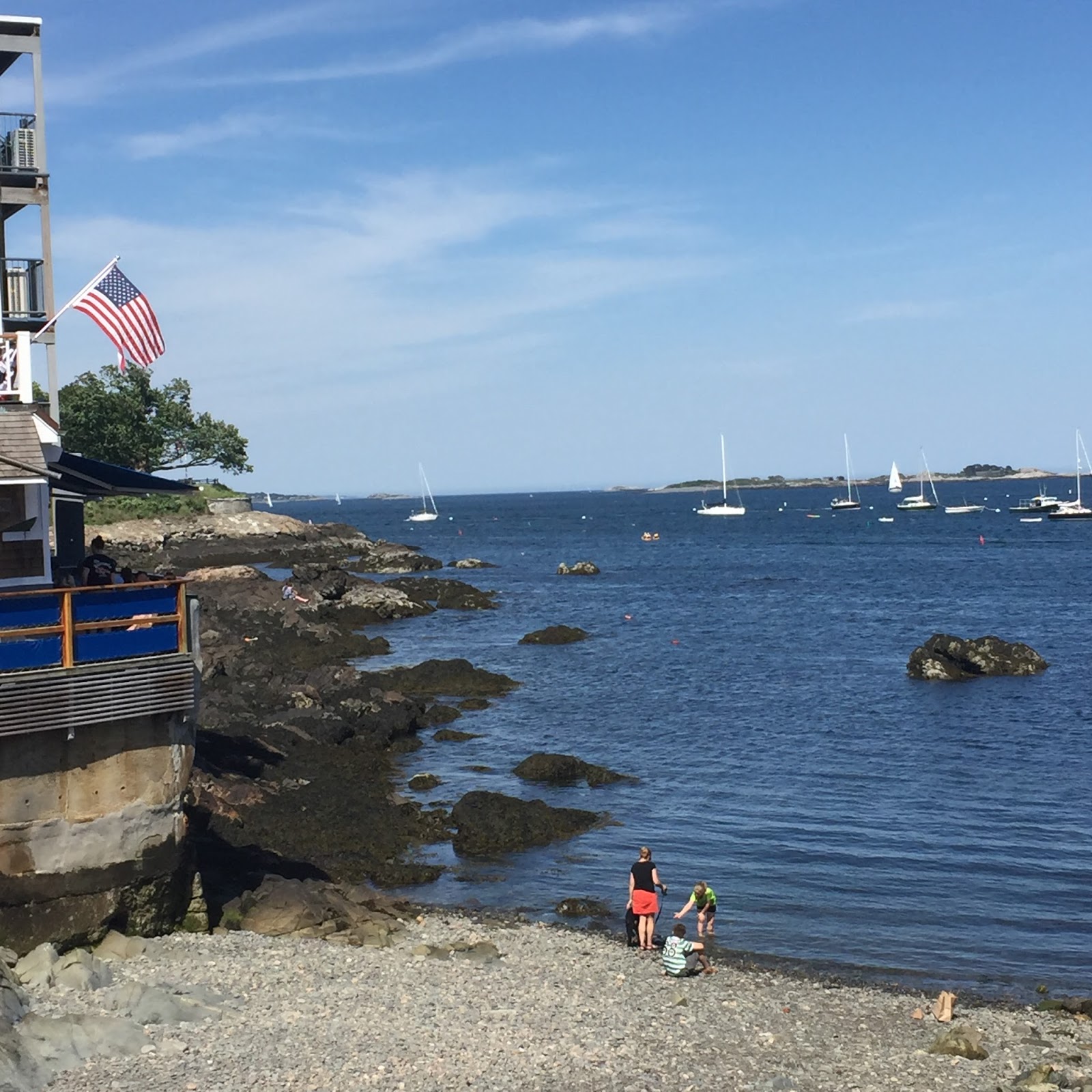
Welcome...

This blog serves as a behind-the-scenes peek into the life and journal of an interdisciplinary artist. Learn more at merliguerra.com or luminariumdance.org, and thank you for reading my thoughts on setting the visual and performing arts into motion.
Showing posts with label Artists. Show all posts

Thursday, April 30, 2020

Red is the color of music

Childhood is a funny thing. For its inhabitants, it seems to go on indefinitely, yet in truth, it’s gone in an instant. Moments we take for granted as children later become cognitive snapshots we second-guess as adults—Was his mustache really that scratchy? Was the pool really that deep?—yet regardless, they leave a lasting impression, an invisible part of ourselves that impacts our lives moving forward, be they realistic memories or those warped through rose-colored glasses.

But when your cousin, Becky, one decade older than you openly shares her childhood memories of the grandmother you both shared, and they match your own nearly word for word, you know that your memories are not only accurate, but that the woman they depict really did, and does continue to, impact your life significantly.


When I think of my father’s mother, my Noni, I think of the color blue. Perhaps it’s because of the blue kitchen in which so many feasts were created and multiple conversations shouted across roomfuls of relatives (Many of whom I later learned weren’t relatives at all! But were always warmly treated as such.); maybe it’s because of the blue water of the above-ground swimming pool my cousins and I basically lived in during the summers (and that I accidentally nearly drowned my brother in, as I tried to teach him how to swim!); or maybe it’s simply due to the color of Noni and Pop Pop’s house—the feeling of sheer excitement upon seeing that blue exterior as we pulled into the packed driveway, and the accompanying sadness upon watching it (and my waving grandparents) gradually disappear as we left for home. 


Pieces: Window Pane #2. Merli V. Guerra, 2017.

Blue was the color of happiness, of a warm embrace, of being passed from aunt to uncle to who-knows-who; blue was the color of the carpeted stairs that Erin, Jack, and I would slide down until we had rug burns or hit the floor a bit too hard; blue was the color of the ever-popular tacky backdrops in our annual school portraits that (although deeply embarrassing to look at) were always proudly displayed among dozens of other photos, old and new, on the wall above the living room sofa. And in later years (when I lived with her in the summer of 2009), blue was the color of my Noni’s nightgown, as we sat on that sofa: her, sassily teasing me and offering me food to the point of giggling and winking at me when I’d inevitably give in; me, sassing her back to make her laugh, and answering that evening’s three repeating questions with varying answers to keep us both entertained (as by then, her Alzheimer’s had truly begun to set in, especially in the evenings).

But red—red was the color of music.


Pieces: Window Pane #9. Merli V. Guerra, 2017.

As a lifelong professional-level pianist and organist, my Noni played every mass, every wedding, every funeral, all while teaching quite literally every child in “Western Mass” weekly piano lessons from the small music room in their home. Family gatherings would naturally spur impromptu duets between Pop Pop on bass or guitar and Noni on piano, with a Pied-Piper flock of grand- and great-grandchildren huddled round and adding the occasional spirited (yet out of tune) chord on the other end of the keys, which was always welcomed with laughter and delight. Between my Italian grandmother and Portuguese grandfather, food was certainly a huge part of every visit (You could show up unannounced and somehow there would undoubtedly be a roast chicken in the oven!), yet I would argue that despite every DIY Network show saying “the kitchen is the heart of every household,” here, at the Guerra’s, it was the music room that was the heart. While living with Noni years later, I’d awake (far too early) to sounds of Mozart and Beethoven—at times, romantic and passionate, at others fiery and complex—but always red. Red as the blood in her veins, the blood we share; red as the dress adorned by the pianist in the painting opposite her in the room. Red was, and continues to be, the color of music.


Noni and Pop Pop, assorted images.

Fast-forward to 2017: As the year started, I was already knee-deep in my We Create project, having begun my work as one of its selected 2016-17 cohort artists in September. I was honored to be chosen for this project run by Marsha Parrilla, Director of Danza Orgánica, and although I ultimately found the 2017 We Create Festival to be largely flawed in its execution, the piece I created through this process turned out to be quite poignant in more ways than one.

Through April, I continued to research and develop my initial concept: delving into the cohort’s 2016-17 theme of “hidden stories” by creating an art installation recognizing those with physical and mental disabilities. As my work unfolded, I found myself narrowing in on the specific story of my Noni’s struggle with Alzheimer’s, and society’s habit of tucking Alzheimer’s patients away—glancing by them only on the surface, unaware of the beautiful, multifaceted lives hidden within.

After many early sketches and conceptual notes, I eventually landed on the concept of peering through a window (itself, taken from the wall of my childhood bedroom, since knocked down…luckily, like me, my dad keeps everything!), to find layers of overlapping memories (some complete, some missing sections, and others seemingly looping on repeat), as this is often what Alzheimer’s does to the brain.


Pieces: The making of. Merli V. Guerra, 2017.


The construction process was difficult, as I knew I wanted each layer to consist of varying opacities, to blur into one another once eventually backlit by a simple table lamp. Scanning old photographs, I spent hours delicately taping tissue paper to cardstock, successfully printing one image, only to jam my printer on the next. By the time I reached the textual memories I planned to incorporate, I’d gotten a bit smarter (so I thought) by purchasing semi-opaque plastic film, only to learn the hard way that ink takes way longer to dry on plastic than it does on pulp! Ink-smudged hands and a healthy portion of swearing later, I embarked on the most tedious task yet: intricately hanging each image with thread onto thin wooden dowels acting as a trellis above.
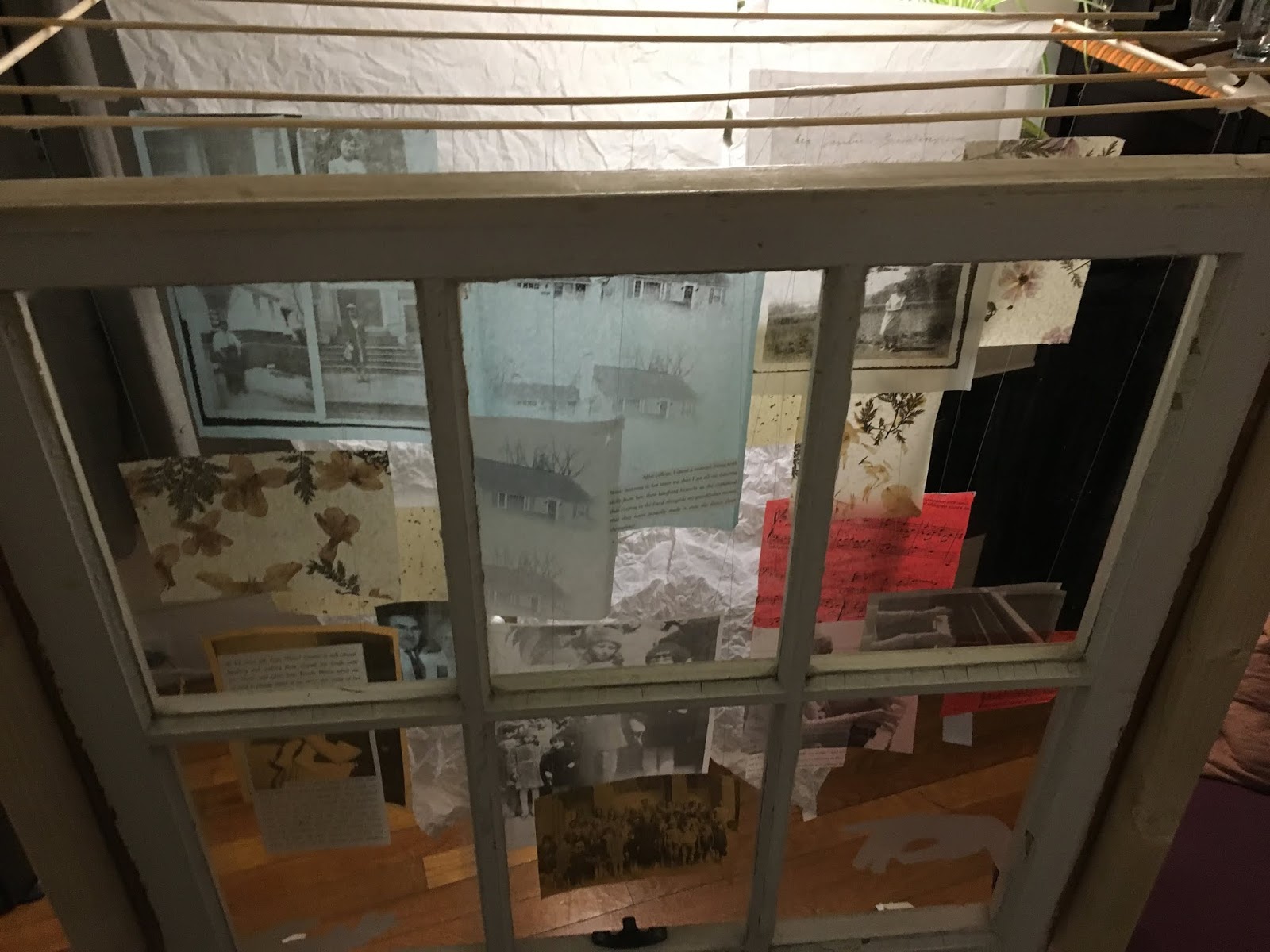

Pieces: The making of. Merli V. Guerra, 2017.

Setting the full installation up in my tiny Boston living room, I was so pleased. Visually, the lamp, window, and images of Noni reminded me vividly of every evening visit on my way to and from Mount Holyoke College as an undergraduate, peering through the living room window to find her doing her crossword by lamplight. Symbolically, I was putting into physical form the age-old saying “Eyes are the window to the soul,” while the lamp served as the human spirit—still bright and beaming behind all those layers of misaligned memories.


Pieces. Merli V. Guerra, 2017.

My intention was to place an empty chair in front of the installation, encouraging audience members to sit and peer through the window panes, piecing together bits of the puzzle and learning about this beautiful multi-faceted woman by simply taking the time to do so. The goal was to speak to Alzheimer’s (and society’s treatment of the elderly) as a whole, reminding viewers that simply because an older individual might be slow to respond, it is not for a lack of knowledge, as they have years more experience than we, ourselves, have known. There are stories there, and when given the time, the patience, to peer through those eyes, we too can piece together the puzzles of these memories, and construct a truer image of who this person is, not was.


Pieces. Merli V. Guerra, 2017.

 I will keep this next section brief, as I do not want to dwell on my negative experience with the We Create process, but its outcome is key to the full experience of my installation, which I had titled Pieces. Explaining to Marsha just how delicate and complex an installation this was, I inquired if I should be setting it up during tech on Wednesday, or setting it up directly before opening night on Friday, as I wanted to be sure it wasn’t damaged in between. (My project was the only one that was an installation piece; the rest were various performance art works.) After being told Wednesday was definitely the day to do it, I carefully and lovingly spent a full two hours setting up the piece, complete with the chair, a lamp from our home, and a small write-up on the work.

Two days later, Sean and I entered the space to a bustling audience, a clearly lit stage, and—to my shock—no installation. I felt my heart plummet, as if I’d misplaced Noni herself somewhere in the room. Where could it be?? With Sean’s help, we eventually found it: literally shoved into a corner, the chair gone, the lamp unplugged, and several of my delicate tissue paper memories torn.


Delicately installing Pieces. Merli V. Guerra, 2017.

I was heart-broken, as my mind instantly replayed one of my “bad” visits with Noni earlier that year. I had shown up at her center to find her, and ten others, lined up along the wall in their wheelchairs waiting to be wheeled into the dining hall, and while I completely understand that the staff can only be in so many places at once, my Noni was at the end of the row, tucked around the corner, anxious and confused. I tried to calm her; tried to explain where she was and where she was heading next. I tried to show her photos of my parents; tried to remind her I was “the dancer” as she always called me (she regularly “auditioned” for my dance company while gliding through her kitchen in later years), yet nothing worked. Over and over she repeated, while crying, “I’m sorry; I’m so sorry I don’t know you. I’m so sorry I don’t remember these people. I’m so sorry I don’t remember who I am.” I held it together until the staff came to wheel her to lunch, then sat in my car and sobbed—not because she didn’t remember me, but because she was apologizing for forgetting herself.

It was amazing to me how the simple act of wheeling her into an empty hallway with no one around, no reminders of her family (photos, music), and no one to talk to, had led to that light briefly going out. And now here I was, staring at my forgotten installation—an installation whose purpose was to actively remind the public not to bypass the elderly by leaving them alone in a hallway (but to sit with them and learn from them), literally pushed aside, forgotten, and abandoned. As I hurriedly reset the now damaged work with Sean, the symbolism of this incident was lost on neither of us. (I later learned that the performance space serves as an after-school program for kids during the day, hence the installation was moved for “safety” reasons. My instinct to arrive early on opening night had been the correct one.)

Pieces: Window Pane #7. Merli V. Guerra, 2017.

As we left that night, taking Pieces home with us, a gust of wind hit us moments before placing the installation inside the car, causing all of my intricately threaded memories to instantly knot and entwine, as if permanently damaged. It seemed beyond hope to untangle it, nor did I know of another event I’d be showcasing it at down the road, yet I still felt compelled to make it right. As if performing a ritual, I spent hours upon hours carefully unbraiding each strand until all were back in their rightful place. I packaged it up for safe travel to our next destination, and it hasn’t been opened since.


Photo: Quincy Guerra Hepburn, 2020.

Fast-forward one last time to now: mid-April 2020. Never in my wildest thoughts would I have known that the entire world would be in quarantine; that my Noni (despite the staff taking incredible precautions) would be diagnosed with COVID-19; and that my family would be visiting her exactly as my installation had portrayed: spending time with her by peering through a window, sharing memories, and enjoying that precious light emanating from her soul as flickers of memories, her signature humor, and boundless love glow from the other side of the glass.

As I write this, I am trapped in New Jersey, whose quarantine is strictly enforced, and beside me (by pure chance), among all my disheveled art projects since moving into our new home, is the damaged, yet carefully preserved installation. I cannot drive up to stand outside the window; and even if I could, I cannot indulge in the comforting “blue” of that warm embrace; but there is one thing I can hold onto: This past December, not long after her 95th birthday, I visited Noni on the second floor of her building. Perhaps my hours of installation detanglement were finally paying off, because from the moment I entered the room, Noni and I shared the most incredibly lucid, loving, and joyous 2.5 hour visit (with poor Sean and Banksy waiting patiently in the car). “Where’s Sean?” she would ask, “He’s just so handsome.” “He has a bad cold, Noni!” I replied, “He didn’t want to take a chance and make you sick.” “But he’s so handsome,” she insisted (with a twinkle in her eye), “I’ll take that chance!”


Photo: Quincy Guerra Hepburn, 2020.

And so we sat together, chatting away like old times, showing her photos and videos from our summer trip to Scotland, photos of hikes in New Jersey during the fall, videos (on her request) of my recent choreography, and as I showed her a sweet video of Banksy opening an early Christmas present in my parents’ family room a few days prior, she suddenly paused—her hands cupping mine around the phone. “Play it again,” she said, peering closer, and so I did. Her eyes brimmed with tears as she pointed above my pup to the guitar on the wall, “That’s John’s. That’s John’s guitar!” “Yes, Noni!” I exclaimed, having become so used to my grandfather's guitar being there that I’d nearly forgotten. “Johnny, your grandson, plays it now.” She shook her head, crying yet smiling, “That’s so good. That’s so good… You know,” she reminded me, “John and I could never dance like you—we were too busy playing in the band; we never learned to dance!” Laughter returned to her soul, and I listened to her reminisce about my Pop Pop, her true love, and their deep connection through music.

And so, as I sit here feeling so far away, I will hold onto the fact that she and my Pop Pop will soon be reunited—a vibrant red reunion—for red is the color of music; their music.

_________________________________________

ADDENDUM: I completed writing this post on Thursday, April 30th, 2020, a little before 7pm. I read it aloud to Sean, sent it to my cousin, then heard the phone ring—my Noni had passed away just after 7pm.

This post is lovingly dedicated to Francesca Cristina Guerra (1924-2020). 

Monday, February 12, 2018

Que vous avez inspiré...

I've spoken these words on my blog in the past, and I'll say them again: I may not be "religious" in the traditional sense, but I am a firm believer in the power of synchronicity to make me pause and appreciate the interconnectedness of this complex universe of ours as a whole.

This summer I found myself caught in the swirl of one such synchronous moment—so personally profound that that I'm documenting and sharing it here. Sean and I traveled to Quebec this summer for a wedding, and while there, came across an artist's work that spoke to us both. Yet as the weekend went on, and Sean debated purchasing a piece, I was surprised to find that this artist's work meant more to me than I initially realized. Perhaps the best way to tell the story is to simply share the email I sent to the artist once we returned home. Here it is, in my rusty French, and then translated into English below.

IN FRENCH
Subject: Bonjour d'un artiste que vous avez inspiré...

Chère Sonia, 
J'ai récemment acheté une de vos magnifiques œuvres d'art, et cela m'a causé une expérience très émouvante. Quelques mois plus tard, je prends maintenant le temps de vous écrire et de vous raconter comment vos œuvres d'art sont importantes pour moi depuis mon enfance. Cette note est émouvante pour moi d'écrire, et j'espère que c'est bien reçu! 
Quand j'étais une jeune fille, mes parents m'ont emmené avec mon frère et moi en vacances à Québec, à partir de notre maison à Boston, MA, États-Unis. Je me souviens de tomber amoureux de la vieille architecture de la ville, de son histoire, et surtout de ses ruelles cachées pleines d'artistes de rue. À Boston, je n'avais jamais vu des artistes montrer leur travail dans les rues, alors c'était spécial pour moi. 
Mes parents sont des partisans des arts et ils m'ont aussi inculqué l'amour de l'art. Un jour de notre voyage, nous sommes retournés à la ruelle avec des stands d'art, et mes parents m'ont invité à choisir une œuvre d'art pour ma chambre. De toutes les œuvres d'art de la rue, l'une d'elles se détachait: une gravure minimaliste de deux ours bruns qui marchaient dans la neige. À l'époque, tout dans ma chambre était lumineux et joyeux, avec des papillons et des ballerines décorant mes murs. Pourtant j'étais là, tenant une gravure sombre, brune et blanche, contrairement à tout ce que j'avais déjà exprimé mon intérêt. 
Surpris par mon choix, mes parents m'ont demandé si j'étais sûr que c'était celui que je voulais, et pas l'arbre à fleurs qui était à côté de cela qu'ils envisageaient d'acheter. Je me suis immédiatement découragé et j'ai retourné les ours, mais je l'ai toujours regretté.
Seize ans plus tard, je suis maintenant un danseur professionnel et un artiste interdisciplinaire, avec un amour de l'art visuel. Il n'y a pas de fées dans ma chambre, mais mon mari (Sean) et moi avons décoré nos murs avec des œuvres d'art que nous avons collectionnées dans le monde entier. 
En juillet, Sean et moi sommes allés au Québec pour un mariage (juste un mois avant notre propre mariage!). C'était la première fois de Sean au Québec, et ma première fois depuis 2001. Chaque fois que mon mari voyage dans un nouveau pays, il cherche un «souvenir» fidèle à la région, signé par l'artiste, et idéalement il rencontre l'artiste. C'est parfois difficile à accomplir! Mais cela devient un ajout mémorable à notre maison. 
Quand nous avons trouvé une rue avec des artistes (y compris de nombreuses gravures à vendre), il est devenu très excité, tout comme moi. Nous avons tous deux convenu que le premier artiste était de loin supérieur en détail et imagination aux autres gravures que nous avions vues. Mais Sean hésitait à acheter l'œuvre car elle représentait des sites que nous n'avions pas visités.

Cette nuit-là, il m'a demandé mon avis, et je lui ai parlé de la belle gravure d'ours qui ne correspondait pas tout à fait à mon style habituel, mais que j'avais toujours regretté de laisser derrière elle. "Ironiquement", ai-je dit, "c'est arrivé ici au Québec, et c'était une gravure de technique similaire à ce que vous aimez." 
Le lendemain, nous sommes retournés au stand d'art. L'homme qui regardait le stand se souvenait de nous et a montré à Sean plus d'œuvres d'art, jusqu'à ce qu'il en trouve un qui combinait notre amour de l'histoire et l'idée de la ville de Québec «alors et maintenant». C'était parfait. 
Il a ensuite demandé si nous étions familiers avec la façon dont les gravures sont faites, et a commencé à nous montrer de vieilles photos des travaux en cours. En feuilletant le livre, mon cœur s'est arrêté. Là, dans l'une des photos, il y avait mes ours bruns perdus depuis longtemps dans la neige, en cours de création. Je ne pouvais pas le croire! J'aurais dû dire quelque chose, mais je me suis figé. Je ne pouvais littéralement pas croire que toutes ces années plus tard, nous avions trébuché sur la même ruelle et étions tombés amoureux du même artiste. 
Sean a acheté votre œuvre et maintenant elle est encadrée avec nos autres œuvres d'Europe et d'Asie. 
Une semaine plus tard, j'ai raconté toute l'histoire à mes parents. Ils ont trouvé l'information originale avec l'œuvre d'art qu'ils ont achetée en 2001, et bien sûr, il y avait ton nom: Sonia Gilbert. Mon père (qui se sentait mal de ne pas avoir choisi les ours à l'époque) a localisé ton site web et l'oeuvre dont je me souvenais.

Se rendre dans une ville étrangère en tant qu'artiste en herbe et tomber amoureux du travail d'un artiste professionnel, puis tomber amoureux du même artiste seize ans plus tard (maintenant que je suis moi-même artiste professionnel) fut une expérience émotionnelle pour moi. Je voulais partager cette histoire avec vous afin que vous sachiez que les touristes qui passent devant votre stand n'oublient pas votre travail. Pour certains spectateurs, votre travail les inspire pour les années à venir. 
Je vous remercie,
Merli

IN ENGLISH
Subject: Thank you from an artist you inspired...

Dear Sonia,

I recently bought one of your beautiful works of art, and it was a very moving experience for me. A few months later, I am now taking the time to write to you and tell you how your art has been important to me since my childhood. This note is emotional for me to write, and I hope it is well received!

When I was a girl, my parents took my brother and me on vacation to Quebec, from our home in Boston, MA, USA. I remember falling in love with the old architecture of the city, its history, and especially its hidden streets full of street artists. In Boston, I had never seen artists show their work on the streets, so it was special for me.

My parents are supporters of the arts and they also instilled in me the love of art. One day of our trip, we returned to the alley with art booths, and my parents invited me to choose a piece of art for my room. Of all the works of art in the street, one of them stood out: a minimalist engraving of two brown bears walking in the snow. At the time, everything in my room was bright and cheerful, with butterflies and ballerinas decorating my walls. Yet there I was, holding a dark, brown and white engraving, contrary to any of my prior interests.

Surprised by my choice, my parents asked me if I was sure it was the one I wanted, and not the flower tree that was next to that they were considering buying. I immediately became discouraged and returned the bears, but I have always regretted it.

Sixteen years later, I am now a professional dancer and an interdisciplinary artist, with a love of visual art. There are no fairies in my room, but my husband (Sean) and I decorate our walls with works of art that we have collected from around the world.

In July, Sean and I went to Quebec for a wedding (just a month before our own wedding!). It was Sean's first time in Quebec, and my first time since 2001. Whenever my husband travels to a new country, he looks for a "souvenir" true to the region, signed by the artist, and ideally he meets the artist. It is sometimes difficult to accomplish! But it becomes a memorable addition to our home.

When we found a street with artists (including many prints for sale), he became very excited, just like me. We both agreed that the first artist was far superior in detail and imagination to the other prints we had seen. But Sean was reluctant to buy the work because it depicted sites we had not visited.

That night, he asked me for my opinion, and I told him about the beautiful engraving of a bear that did not quite fit my usual style, but that I had always regretted leaving behind. "Ironically," I said, "it happened here in Quebec, and it was an engraving similar to what you like."

The next day we went back to the art booth. The man who was watching the stand remembered us and showed Sean more works of art, until he found one that combined our love of history with the idea of ​​the city of Quebec "then and now." It was perfect.

He then asked if we were familiar with how the prints were made, and started showing us old pictures of the work in progress. Leafing through the book, my heart stopped. There, in one of the pictures, were my brown bears long lost in the snow, being created. I could not believe it! I should have said something, but I froze. I literally could not believe that all these years later, we had stumbled onto the same alley and fallen in love with the same artist.

Sean bought your work and now it is framed with our other works from Europe and Asia.

A week later, I told the story to my parents. They found the original information with the artwork they bought in 2001, and of course, there was your name: Sonia Gilbert. My father (who felt bad about me not choosing the bears at the time) located your website and the work I remembered.

Going to a foreign city as an aspiring artist and falling in love with the work of a professional artist, then falling in love with the same artist sixteen years later (now that I'm a professional artist myself) was an emotional experience for me. I wanted to share this story with you so that you know that the tourists who pass by your booth do not forget your work. For some viewers, your work inspires them for years to come.

Thank you,
Merli
Much to my excitement, I soon received the following reply.

IN FRENCH
Je suis très émue !!! 
Votre courriel a rempli de fierté ma fille et mon amoureux..., ce qui me touche énormément ! 
C'est une belle histoire et c'est une grande récompense pour mon labeur. 
J'ai inculque l'amour des arts à ma fille et ça me touche que d'autres suivent ce chemin qui élève le cœur et l'esprit des humains. 
Je fais la même chose que vous lorsque je voyage. J'encourage les artistes ! 
J'aime, à la fin de la saison, me rendre sur la Rue du Trésor pour rencontrer les gens, mes gens. Cela me donne beaucoup d'énergie et votre courriel me remplie de bonheur. 
Vous êtes très belle ! 
J'aimerais votre adresse postale si cela ne vous ennuie pas. 
Merci beaucoup.
Sonia Gilbert

IN ENGLISH
I am very moved !!! 
Your email has filled with pride my daughter and my boyfriend ... it affects me tremendously! 
It's a great story and it's a great reward for my toil. 
I instills the love of art with my daughter and it touches me that others follow this path that elevates the heart and mind of humans. 
I'm the same as you when I travel. I encourage artists! 
Like at the end of the season, go on the street Treasury to meet the people, my people. This gives me a lot of energy and email filled me with happiness. 
You are very beautiful ! 
I would like your mailing address if you do not mind. 
Thank you very much.
Sonia Gilbert


A few months later, I received in the mail an intricate, tiny print of a hummingbird. Such a gorgeous gesture! In turn, I sent Sonia a small bundle of seed packets (Botanical Interests uses artwork on all of their seed packets—simply beautiful) to attract hummingbirds to her garden. Sure enough, she replied that she does love to garden and looks forward to planting them in the Spring.


So there it is: Another moment, seemingly just like any other, until that swirl of energy catches you up and you realize you've been here before. Only this time, you realize you did take the bears home with you after all—in fact, you've carried them with you every day since.

Sunday, February 5, 2017

Hooked

I’m hooked.

On what?, you might ask. On glass.

There are so many elements of glass that excite me: How its texture can vary from silky to rough to sharp; how it can take a beam of light and dissolve it into an array of colors; how it can magnify or minimize; how it can encapsulate air bubbles; and how it’s actually an amorphous solid. All of these properties captivate me, and have for years.


Marblehead, MA.
My brother shows off the perfect gradient rainbow of colors he's found in one afternoon, including the ever-sought-after red sea glass. 

In trying to pinpoint when it began, I realize now that I can’t quite find a start. Was it when playing with my dad’s case of telescope lenses, overlapping the different circles of colored glass while carefully avoiding touching the surface? Or was it while looking for sea glass on the beach with my family in the summer, learning the chemistry (and more importantly the history) behind every color, every piece? Or maybe it was watching it being worked with for the first time, sitting on a bench in the sweltering studio at Simon Pearce in Vermont, studying skilled artisans as they turned glowing orbs into smooth, crystalline stemware.


Now we are here. Co-choreographed by Merli V. Guerra and Kimberleigh A. Holman, 2012. Photo: Jim Coleman.

Throughout my professional career, I’ve used glass as both a medium with which to work and an inspiration from which to conceptualize—from the glowing bulbs of Andromeda to the finger-smudged window panes of Now we are here. Now, as I head into a new project with the Fuller Craft Museum, I have been given an opportunity to create a "breathing installation" of dance and art that revolves solely around glass itself.

In an effort to research this topic up close (and because she knows me and my interests better than nearly anyone), Kim surprised me with possibly my favorite gift to date: A glass blowing class for two, and a scribbled note about how the person I brought didn't have to be her. (Please! As if it wouldn't be.)


Three months later, there we were: standing awkwardly in a class of four as our chill instructor casually meandered through us with a slowly dripping glob of molten glass on the end of a metal tube. As beginners, we were given the options of garden ball, paperweight, or pumpkin. I found myself staring into the intricately detailed swirls of color trapped inside each paperweight, as if tiny planets sitting on a shelf, and knew I had to create one. So did Kim, though her interest seemed to be focused more so on the satisfying feeling of rolling the paperweight around in her hands. (Again, as if this wouldn't be the case.)


Having both chosen to create a paperweight, I was struck by the heat I felt not only from the ovens but from the glass itself. My knuckles felt uncomfortably close to burning as I held a board against Kim's glass to help her shape it into a sphere, much like reaching just a little too far into a campfire to toast that last marshmallow.


As for color, we were surprised to find large buckets of tiny colored chips that we would roll our clear glass through. Our instructor helped us determine the right proportion of chips to give us the different looks we were aiming to achieve. Taking mine out of the kiln, I was a bit over zealous when told I could add air bubbles and twists with a large pair of tongs next to me—I was just so eager to witness for myself how malleable it was! Cooling quickly, the glass went from feeling like a chewed piece of gum to crystalized honey, and it took surprising effort to pry it into shape.

Two days later, it was time to head back to the studio in search of our fully cooled paperweights. The results speak for themselves:

Kim's "Ursula-the-seawitch-the-paperweight."

Merli's "Earth, as seen from the atmosphere."


So here we are, a few weeks later, and I'm still thinking daily about what could be next in my glass explorations. I'm 100% smitten with the medium, and only half-joking with Kim that one of us should build a kiln in the basement (perhaps the one who doesn't currently have a security deposit?). From broken on the floor, to fully formed on my shelf, to washed ashore as glowing pebbles, glass always catches my eye with beauty, light, and intrigue.


Till the next time, Glass...


SaveSave

Friday, January 27, 2017

2017: Off and Running!

As a reviewer for the Fjord Review, my weekends often involve press releases, packed theaters, and notes scribbled in the dark.


Here we are—just four brisk weeks into the new year and already my plate is full with new projects, culminating events, and guest invitations now through April (and then some, but let’s focus on the next three months for now).

First, a recap of what these projects are:

Voices From the Future: I’ll be participating in Voices From the Future with a voice from the past. Luminarium company member Alison McHorney will perform the one-minute solo from my 2016 work The Grass Never Grows, set to a score of spoken poetry, at this event celebrating the LGBTQ community.

Concert at Longy Hall: Friend and colleague Mel Fitzhugh—a composer whose personal story and professional work are equally intriguing—has invited me to once again perform an improvisationally-inspired choreographic solo alongside cellist Christien Beeuwkes, this time for an afternoon performance of Mel’s musical works at Longy Hall. The concert will take place February 26, 2017.

Mad World: Aurora Borealis has selected Luminarium to be its Guest Artist for its Spring concert Mad World on March 11th, and has specifically asked us to bring my Phoenixial Cycle duet, last presented at the State House in Boston.

Five College Dance Department Careers Panel: I’m thrilled to be representing Mount Holyoke College’s impressive array of Dance Department alumnae at this event. On March 31st, one alum from each of the Five Colleges (Amherst, Mount Holyoke, Smith, UMass, and Hampshire) in the five-college consortium will speak about their careers, advising current students studying in the field. I feel honored to represent my alma mater, and look forward to connecting with future choreographers (hopefully coming to Boston)!

We Create Festival: I’ve been a part of the 2016-17 cohort since September and have been developing new work with the guidance of my project mentor (and longtime friend) Jenny Zuk, developing an art installation exploring the theme of “hidden stories,” as it pertains to those with physical and/or mental disabilities. The culminating performance and exhibition viewing will take place April 8, 2017.

Kinetic Craft: For my annual Cultural Community Outreach Project (which is now in its 6th year), Luminarium will be in residence at the Fuller Craft Museum in Brockton for the entire week of April school vacation (10-5pm Tuesday, April 18 through Sunday, April 23, 2017). I’m constructing a series of “breathing installations”—a concept I first developed back in 2011 with Luminarium’s fabric installation at the Boston Center for the Arts’ Movement at the Mills—highlighting the five crafting elements: Textiles, Ceramics, Wood, Glass, and Metal. I’ve invited Kim to join me by creating the Ceramics installation, while I continue to develop the other four, each of which will have a dancer performing inside as part of the installation, around the clock.

Boston New Music Initiative’s Spring Concert: Last year, Luminarium was commissioned to create two new choreographic works to accompany two of the musical scores selected from BNMI's international call to artists. I’m excited to be working on a new work, set to John Allemeier’s The Devil’s Turn. This performance of live music and dance will take place at the Armory in Somerville, MA, on April 22nd.

...

That’s the update for now. This quarter is packed with projects and events that lend themselves to interdisciplinary creation and collaboration—AKA, my favorite kind of work! As we speak, my bag contains a notebook full of thoughts and sketches, a 21-page musical score, a crumpled Groupon from Kim and my recent glassblowing adventure (research for Kinetic Craft), and a planner full of upcoming interviews and casual conversations scheduled with mentors and artists (often outside my primary discipline) to further enhance my work.

If this first quarter is any indication, 2017 is going to be an intense and invigorating year. Bring it on!


Friday, March 18, 2016

The Wayside Inn: Early Sketches

Each season I push myself to chronicle the development of the major projects I embark on through Luminarium. It's amazing how quickly a few still images floating across my mind turn to active ideas, planning, and physical motion. Even in the one month since sending Kim my first sketches, I am now further engaged (and steadily en route to being fully "entrenched") in the project. Thus, let the documenting begin.

It's probably getting old by now to read this sentence, but for those just joining, every season I create and lead Luminarium's Cultural Community Outreach Project—using dance and art to highlight a local cultural or historic landmark. Past examples have taken me to Concord (Celebration of Preservation, Louisa May Alcott's Orchard House, 2012), Lowell (Threading Motion Project, New England Quilt Museum, 2013), Arlington (Night at the Tower, Arlington Reservoir Water Tower, 2014), and Amherst (Amherst Storybook Project, Eric Carle Museum of Picture Book Art, 2015). This year marks the monumental fifth iteration of this annual endeavor, and—thanks to a grant from the Sudbury Cultural Council—will highlight the 300th anniversary of the historic Wayside Inn of Sudbury, MA.

So much has already begun to develop since my initial concept of presenting three new works, each one celebrating the Inn's 300 years while focusing on an integral aspect of the landmark: The Inn, the gristmill, and the land. The project began in September with a cold call to the Wayside Inn; the grant application was then submitted in October; funding was awarded in January; and in February I sent Kim the following preliminary notes and images darting through my mind for the event:


The Film
(Focus on the mill)

Either a piece filmed inside the mill, or projected onto various parts of it—including potentially the waterfall. 

Digital sketch for Merli V. Guerra's upcoming project at The Wayside Inn, 2016.

The Petticoat Piece 
(Focus on the inn within the greater context of the world) 
This is the piece I'm envisioning expanding upon (or if I finish it in time, simply re-showing) for our Feature Production. I've been culling through the inn's journal entries from 1920 onwards (will need to inquire about older ones), and I'd like to use snippets about the people who stayed, the greater context of the war overseas and some beautiful quotes from the inn keeper at the time about wishing everyone could feel the joy and peace felt at the inn. It was a meeting ground for people reentering the country, and those shipping off. Some really incredible stories passed through this space! 


Current Sketch (different petticoats to symbolize different eras) 

Digital sketch for Merli V. Guerra's upcoming project at The Wayside Inn, 2016.

Alternatively: Giving each dancer 3 (layered) slips, one per century to gradually reveal, from multi-hoop to single-hoop to pencil slip.

The Land
This is where I'm stuck. I don't necessarily think I need to stick to the idea of the land if I want to change it, but so far nothing's really struck me for how to move forward.

One extra or alternative piece
I have an idea for one piece: To have it be a comical, quick-paced rundown of the history of the place, good for kids. We'll see...


One month later, these thoughts have since expanded, brought on new creators, and rehearsals have officially begun. Kim felt inspired by the concept of the land and has since taken that work on, and Mali Sastri of the powerful band Jaggery will be joining us on this project as we create a new work coupling her impressive music talents with our choreography. All in all, the project is off and running!

In the meantime, Luminarium has since created that "extra" piece—portraying 300 years of history through a delightfully whimsical 3-minute performance piece—and last night held a special video shoot for the project. We've all seen plenty of beautiful photos of dancers capturing their kinetic energy through the use of flour, but we're tackling this genre from a new angle: The Wayside Inn is home to a 1920s gristmill, using 18th century milling machinery. It is now one of just three remaining operational gristmills in Massachusetts.

In honor of this mill, I'm now working on a new film that will merge dance and flour, to be projected onto performers during the event this July. I've since set aside the waterfall projection concept (though I'm sure this will return in future years). Take a peek at these film stills caught from last night's shoot—step one is now complete.

Film still from Merli V. Guerra's upcoming film for The Wayside Inn, 2016.

Film still from Merli V. Guerra's upcoming film for The Wayside Inn, 2016.

Film still from Merli V. Guerra's upcoming film for The Wayside Inn, 2016.

Film still from Merli V. Guerra's upcoming film for The Wayside Inn, 2016.


View the rest of the image here, and stay tuned for further updates on this exciting project!


Luminarium at the Wayside Inn: 300 Years of History
Sunday, July 10 at noon, 1:30pm, and 3pm
The performance cycle will travel from the barn, across the field, along the brook, and end at the mill. Viewers are encouraged to join the journey at any point of this 30-40 minute performance.


This project is supported in part by a grant from the Sudbury Cultural Council, a branch of the Massachusetts Cultural Council.

Sunday, February 21, 2016

Arts Advocacy in the Great Hall of Flags

Each season, I find myself marveling at an experience I never could have imagined back in 2010 when Luminarium first started. Back then, Kim and I were new to the world of Boston performance venues, to grant-writing, and to speaking on behalf of the arts. With each year that passes, we've continued to expand our experiences, knowledge, and reach—and this week brought a new highlight to the company's memory banks.

Six months ago, the Massachusetts Cultural Council (MCC) reached out to me to inquire if Luminarium would be interested in performing at its prestigious Local Cultural Council (LCC) Statewide Assembly. This day-long event is held every two years in the beautiful Massachusetts State House, celebrating the efforts of the state's 329 local cultural councils, while encouraging state legislators to help these councils fund and further the arts.

Matthew Kyle and Chun-Jou Tsai perform Merli V. Guerra's Phoenixial Cycle at the LCC Statewide Assembly
at the Massachusetts State House, 2016. Photo: Merli V. Guerra.

We were of course thrilled to participate in this event, and immediately began planning. There were some amusing anecdotal hiccups along the way, but in the end, we were proud to present two of Luminarium's recent works: The opening duet from my own Phoenixial Cycle (with performers Matthew Kyle and Chun-Jou Tsai), and Kim's Getting There is Half the Battle (featuring a new cast of myself, Amy, and now Kim!).

Matthew Kyle and Chun-Jou Tsai perform Merli V. Guerra's Phoenixial Cycle at the LCC Statewide Assembly
at the Massachusetts State House, 2016. Photo: Merli V. Guerra.

Blanketed under the quiet glow of a gray afternoon, the company performed in the beautiful (and appropriately named) Great Hall of Flags to perhaps our most appreciative audience to date. We often pride ourselves on our accessibility, performing for audiences made up of art-lovers and new-to-dance viewers alike, yet to have this experience of performing in a room full of the state's top arts and culture supporters was as fulfilling as it was daunting. Fortunately, the energy in the room was palpable, and the hall echoed with uproarious applause following each piece.

Matthew Kyle and Chun-Jou Tsai perform Merli V. Guerra's Phoenixial Cycle at the
LCC Statewide Assembly at the Massachusetts State House, 2016. Photo: Mercure Photography.

Matthew Kyle and Chun-Jou Tsai perform Merli V. Guerra's Phoenixial Cycle at the LCC Statewide Assembly
at the Massachusetts State House, 2016. Photo: Mercure Photography.

l. to r. Amy Mastrangelo and Merli V. Guerra perform Holman's Getting There is Half the Battle
at the LCC Statewide Assembly at the Massachusetts State House, 2016. Photo: Mercure Photography.

l. to r. Kimberleigh A. Holman, Amy Mastrangelo, and Merli V. Guerra perform Holman's Getting There is Half the Battle
at the LCC Statewide Assembly at the Massachusetts State House, 2016. Photo: Chun-Jou Tsai.

l. to r. Amy Mastrangelo and Merli V. Guerra perform Holman's Getting There is Half the Battle at the LCC Statewide
Assembly at the Massachusetts State House, 2016. Photo: Chun-Jou Tsai.

At the Assembly, I found myself wearing not only my performer/choreographer cap, but my speaker cap too, with the opportunity to engage in a discussion near and dear to my heart: How to further enrich communities through the arts. It's the topic that keeps my annual Cultural Community Outreach Project fresh with new ideas each season, and it's a discussion best had with those who are actively engaged in and/or funding the arts in their communities day in, day out.

Merli V. Guerra introduces her co-director Kim Holman and fellow Luminarium company members to keynote speaker
Sally Taylor. Photo: Mercure Photography.

For this event, I was told that I presented the perfect "trifecta" for the panel: As an 11-time LCC grant-winning artist, as recipient of the MCC's prestigious Gold Star Award, and for my recent work on the "ground floor" of the LCCs as Co-Chair of the Arlington Cultural Council. For these three reasons, the MCC invited me to speak as an active member of the LCC community whose reflections would serve to link the panel back to the LCC volunteers filling the room.

It was an honor and a privilege to sit on a panel comprised of Sally Taylor (musician and founder of Consenses), Scarlet Keys (Associate Professor, Berklee College of Music), and Ben Taylor (musician) as MCC Executive Director Anita Walker led the lively discussion as moderator.

Massachusetts Cultural Council Executive Director Anita Walker introduces the morning panel. Photo: Mercure Photography.

l. to r. Sally Taylor, Merli V. Guerra, Ben Taylor, and Scarlet Keys. Photo: Ed Cohen.

l. to r. Sally Taylor and Merli V. Guerra. Photo: Mercure Photography.

Merli V. Guerra speaks on the morning panel at the Local Cultural Council
Statewide Assembly, 2016. Photo: Mercure Photography.

Merli V. Guerra speaks on the morning panel at the Local Cultural Council
Statewide Assembly, 2016. Photo: Mercure Photography.

This panel invitation came at the perfect moment: After six years of working in the arts field, it was only in the past year that I finally acknowledged that the work I put forward extends far beyond myself, my company, and my immediate community. My work instead touches hundreds—thousands, at moments—through the very basic acts of encouraging young artists to grow and explore the world, acting as a mentor to new artistic entrepreneurs, and offering guidance to those entering the realm of grant-writing and government funding. No longer do I describe myself simply as an interdisciplinary artist, but—proudly—as an arts advocate as well.

My snazzy new business cards, kicking off 2016...

All in all, we could not have asked for a more receptive audience for Luminarium, nor could I have asked for a finer group of panelists and MCC staff to work alongside leading up to this event. Goodbye for now, State House... I wonder when we'll next perform inside your prestigious walls?

l. to r. Amy Mastrangelo and Merli V. Guerra perform Holman's
Getting There is Half the Battle at the LCC Statewide Assembly at the
Massachusetts State House, 2016. Photo: Mercure Photography.

Luminarium Dance Company at the Massachusetts State House, 2016. Photo: Ed Cohen.